I don’t read nearly as much as I used to for a lot of reasons: life getting in the way, a greater focus on music, and a greater focus on actually writing among them. I know, I know, “Nor is there singing school but studying / Monuments of its own magnificence….”* The biggest reason, however, is that I’ve almost entirely lost the appetite for fiction. I read too much of that for so long, so much that I longed for something else. And that something else requires a lot more reflection for me than novels every did (I mean I was trained to read those and analyze them to death).
I like to read things that challenge me in different ways these days. Something that makes me look things up to provide further background. Poems that shake me to my core and show me what poetry can truly accomplish in this jaded age. So, if you are looking for novels, look elsewhere..
With that introduction these are the five books that most challenged me and made my “soul clap its hands”* to fill in the blanks from the quote above. Not all of these were released this year, but I read them this year. I’m not including old classics I reread though. I mean I read the Collected Poems of Wallace Stevens this year too, but it didn’t make the list (and it would be top if I did include it because “The Snowman”).
I don’t read as many new books as I listen to new music, so this list represents my favorite books that I read this year, whenever they were released (even though most of them are from this year or last).
*”Sailing to Byzantium by William Butler Yeats, natch.
My five favorites
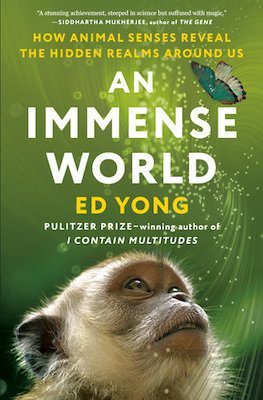
An Immense World: How Animal Senses Reveal the Hidden Realms Around Us – Ed Yong
In An Immense World, Ed Yong coaxes us beyond the confines of our own senses, allowing us to perceive the sensory world, or umwelt, animals—both as familiar you pet dog and as weird as insects masquerading as something else..
This book had some of the most outstanding and quotable writing I’ve seen in a piece of non-fiction in a long time. This could end up on my list of classics that made me think in entirely new ways, joining 1491 and one that will be discussed below.
I mean look at this:
The bat speaks, and a silent world shouts back. (p. 286)
Holy shit what a turn of phrase to describe echolocation!
I honestly took more photos of pages from this book to share than any other book ever (I know that’s a recent thing, but still.
His dog, Typo makes frequent appearances in the book. You do love dogs, don’t you? If you don’t can we truly be friends? Aside aside, this book made me understand Emmy’s and Bhindi’s behavior more than any vet or self-style dog whisperer ever did.
Amazon link.
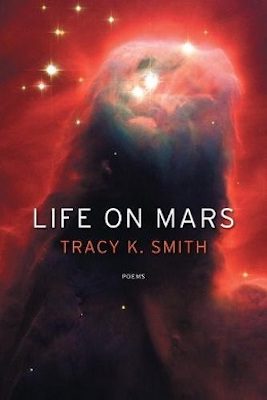
Life on Mars: Poems – Tracy K. Smith
The best collection of poetry I’ve read this century. Full stop. It made a plate of eggs poignant. It’s a rumination on the relationship between a father and a daughter and an elegy for his loss. The father, just so happens to have worked on the Hubble telescope. So the metaphors are literally out of this world. She’s equally comfortable alluding to intestellar travel, David Bowie, and past poets.
Don’t believe me about how awesome this is? Poetry speaks louder in the reading (aloud) than the explication of it, graduate school be damned. This is just representative of how I encountered it (from “My God, It’s Full of Stars”):
We learned new words for things. The decade changed.

The first few pictures came back blurred, and I felt ashamed
For all the cheerful engineers, my father and his tribe. The second time,
The optics jibed. We saw to the edge of all there is—

So brutal and alive it seemed to comprehend us back.
Timely. Eternal. Can dance to it. All checks.
Never mind that it won the Pulitzer Prize a decade ago (2011).
Amazon link.
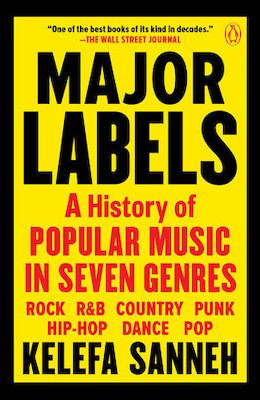
Major Labels: A History of Popular Music in Seven Genres – Kelefa Sanneh
I love music. I loved three of the five genres he deals with in the book going into reading this. Now I can appreciate all five even more that I ever thought possible.
Sanneh and I have our disagreements. His utter lack of thinking about The Clash for instance is but one. But guess what, he explains it well. It was all about timing, of course. I get that. The college radio subculture he describes is incredibly familiar as well.
And Hip-Hop. Oh Hip-Hop. I love big parts of this genre, but I had never before hoped to understand it in the least as the whitest white boy you know. I feel much more grounded know, adding to my own half assed history of the genre.
This is one of the best written books about music that I’ve ever read, even as he explains genres that I never thought would apply to me. He make me see how they connect with everything else.
And he brings enthusiasm to places I never thought someone in his position would be able to do. Take his self avowed love for country music, classic AND modern, for example. See that disagreement thing again on the latter point. That said, I did look at George Strait again with perhaps clearer eyes. And the connection for Garth Brooks to the Pop thread was brilliant.
This book really shines at the end though bringing the thread s of dance and pop together to references everything that has gone before. For those keeping score, I also read he history of music in five songs this eyar, but I chose this one ahead of it.
Amazon link.
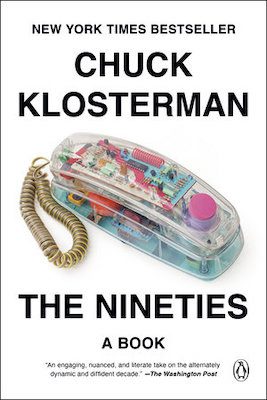
The Nineties: A Book – Chuck Klosterman
For those of us of a certain age, the 90s don’t feel that long ago. But it really sort of is these days, 30 years ago. The Berlin Wall seem like ancient history now, but then, its all was still very fresh in our memories and 9/11 couldn’t even be conceived of in our heads.
But still, the seeds of much that plagues us today were planted in that decade. It was the decade that started with a phone book and ended with a search engine. And through it all Klosterman connects the dots of the under-examine time in history to now. It feeling so close makes us feel that we have a really good handle on what happened then. Read this, and I assure you, you will see how little we actually remember, and even less that we can grapple with.
Klosterman is able to proiveed a lot more depth the to our simple Polaroid picture of grunge kids not giving a fuck, which is accurate but sort of misses the whole point. the decade still had it’s idealism even as the seeds of that idealism’s destruction were planted and began to yield fruit.
Amazon link.
The Dawn of Everything: A New History of Humanity – David Graeber and David Wengrow
This next one, by the strict rules I impose on myself, shouldn’t really qualify. I started reading this over Thanksgiving 2021, but I didn’t finish it until January of this year. So, I didn’t read it entirely this year, but I did finish it, and what a goddam book. So, I make the rules and it’s in.
It upended a lot of what I thought I know (see, 1491 and An Immense World), so I couldn’t let it go without comment.
This book convinced me that everything that I thought I know about the evolution of human society is wrong. This received wisdom, based on false premises from the start, has no actual evidence archeologically.
Instead, the book shows that humanity is very good at trying new ways of organizing itself and shifting and “regressing” as the facts on the ground dictate. We are an experimental lot, and the evidence shows that there is nothing linear about how we organize ourselves.
The question becomes, can we shake our selves out of this rut that really started in the Middle Ages or not?
Amazon link.
Note: all images copyright of their original owners. Images sourced from publishers.