
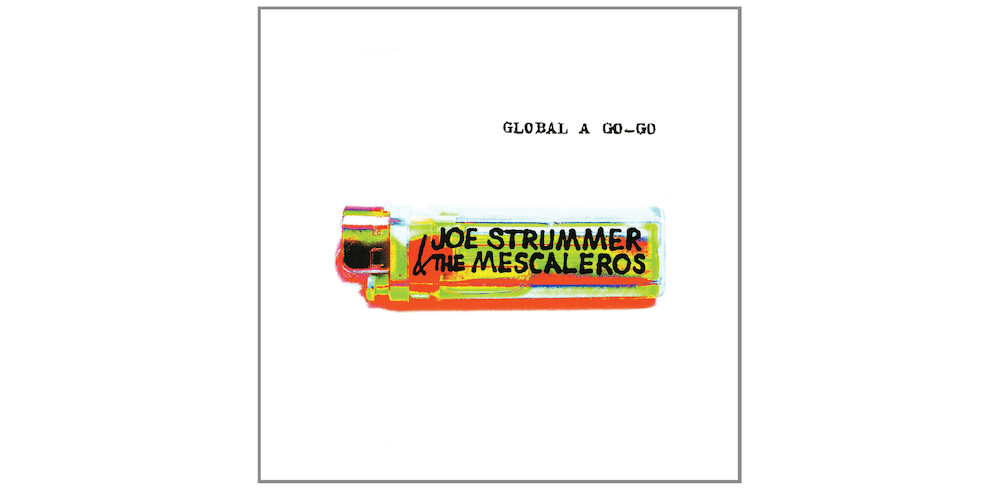
A piece cheerleading for Global a Go-Go written for @bestalbumbrackets.bsky.social best album of 2001 bracket on Bluesky.
Any discussion of Joe Stummer’s music has to begin with the Clash, of course. The Clash were seminal and one of my favorites, but as much as I love them, I’m not here to talk about the Clash other than as introduction. Instead, I’m here to talk about the second album by Joe Strummer & the Mescaleros, Global-a-Go-Go.
To get to an actual appreciation of it, the history between the height of the Clash and Joe’s re-emergence in the late 90s must addressed a bit. This is essential to understanding and appreciating the album.
The dissolution of The Clash was not pretty, and Joe played a huge part in why. When it was finally over, he drifted personally and musically for years. He did some acting, contributed to some soundtracks (Sid & Nancy being the most well-known). Then in 1989, he released Earthquake Weather, his first full length with him totally at the helm

It bombed.
The album wasn’t terrible, but the world had moved on. And so did Joe. In the next ten years, he found some peace with himself and with the world, and the music from all over it. This is evidenced by his London Calling shows on the BBC World Service in the 1990s.
1999, Joe re-emerged with the Mescaleros, releasing, Rock Art and the X-Ray Style. After all the singles, soundtracks, acting, and radio work, he had a band again. One where he set the direction. Rock Art and the X-Ray Style slipped into the world pretty quietly. I mean, new music was the las thing anyone expected. It had a lot of the hallmarks of any first album. It had a few really good songs, but it was also pretty uneven.
Which brings of the 2001 and Global a Go-Go. This record made more of an impression with everyone right off the bat; most critics liked it, comparing it favorably to the previous release. Many though it signaled a resurgence.
I am one of those people as well (even though I only play music critic on the internet from time to time).
It made such an impact on me that my wife and I named our first dog Bhindi. And Minstrel Boy was the recessional at our wedding some seven years later. Joe’s music from this album (and his last) mean almost more to me at my age than any of those excellent Clash records [note: Cut the Crap does not count]. It may have something do with my age; I’m now older than Joe was when he died.
So other than my long existing appreciation of Joe Strummer, what makes this album worthy of a listen?
First, compared with the company it’s keeping with other acclaimed records from this year, it’s a little odder. A world-music informed record coming from a cricket pitch when everyone else was playing baseball. Given what was happening elsewhere with The Strokes and The White Stripes, the joy in this record really stands out.
The Mescaleros were really finding their legs backing Joe too, leaning more heavily on acoustic sounds than any time in his career.
Global a Go-Go is also inhabited by unforgettable characters. It represents the frist time that so many of the songs were so character driven: the Kiwi looking for mushy peas in “Bhindi Bhagee,” the paranoiac in “Gamma Ray,” and the conspiracy theorist in “Johnny Appleseed.” All different. All very vivid. It took until now for anyone to see these short stories in song.
Even solo, this record was as ambitious in its way as Sandinista! was in its. And it had a sense of humor the Clash often lacked, while still experimenting. I’d count “Bhindi Bhagee” and “Johnny Appleseed” among some of the finest songs he’d ever written.
And all that time doing the radio is evident as well. Sure the Clash ventured well beyond the usual punk influences, but here Joe Strummer cast a much wider net: the world. But it also nods heavily to Joe’s roots in Scotland, with the 18-minute version of the traditional song “Minstrel Boy.”
Finally, it was the first time I heard Joe’s music be so humble and joyful. It seemed that he had found peace at long last. Global a Go-Go did nothing to detract from his legacy, but instead, cemented it with a new sound. He was gone less than two years later.
Miss you Joe still.